
[ Blog ]How Ready-Mix Producers Should
Evaluate AI Software in 2026
AI is now part of almost every software conversation in ready-mix. From pricing and dispatch to customer analysis and operations, more platforms are adding AI features and AI language to their offering.
That creates opportunity. It also creates confusion.
In our experience, most producers are not asking whether AI matters. They are asking a more practical question: which AI tools will actually help us improve performance, protect profit, and make faster decisions?
That is the right question.

Not all AI is created equal. Some tools help users retrieve information faster. Some summarize dashboards. Some make reporting easier to navigate. Those capabilities can be useful, but they are not the same as helping a business identify what matters, understand where value is being lost, and decide what to do next.
Start with the business problem
The first question any producer should ask is simple:
What business problem is this AI actually solving?
We have typically seen the strongest results when AI is tied to a clear operational or financial outcome. That might mean identifying margin leakage, uncovering delivery inefficiencies, spotting customer risk, reducing decision latency, or highlighting where costs are climbing.
If the value sounds vague, such as “better visibility” or “smarter reporting,” that should raise concern. Visibility matters, but visibility alone does not improve margins.
Strong AI should improve the business, not simply describe it.Know the difference between information and decision support
This is one of the biggest evaluation mistakes we see.
Many tools can now summarize data, answer basic questions, or generate charts more quickly. That may reduce some friction, but it often leaves the most important work in the hands of the user.
Leaders and teams still have to interpret the output, decide what matters, understand why it changed, and determine what action should happen next.
That is not the same as decision support.
In our experience, better AI should do more than return information. It should help identify priorities, surface problems, explain what is driving the result, and support faster action.
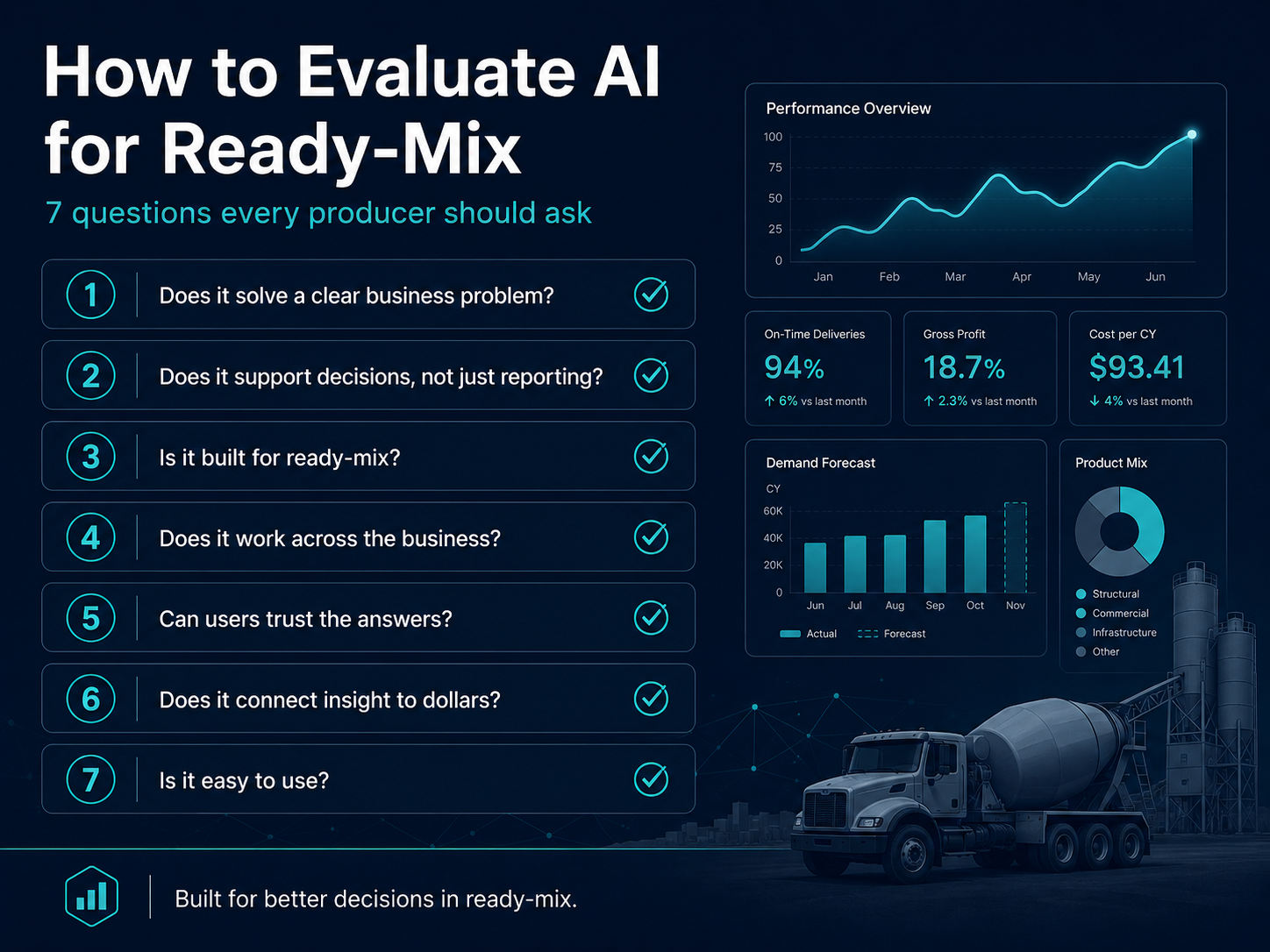
Make sure it is built for ready-mix
Ready-mix is not a generic business, and AI should not be evaluated as if it were one.
Margin, cost-to-serve, delivery performance, wait time, utilization, and product-level profitability all depend on definitions and business rules that are specific to ready-mix. If the AI does not understand those realities, the answer may sound polished without being reliable.
Producers should ask:
- Is this AI purpose-built for ready-mix?
- Does it understand ready-mix KPIs and business logic?
- Can it reflect how our operation actually runs?
In our experience, this is one of the clearest separators between AI that sounds impressive and AI that delivers dependable value.
Evaluate whether it works across the business
One of the most common limitations in AI evaluation is assuming a tool can drive meaningful decisions while only seeing one part of the operation.
Ready-mix performance is shaped across dispatch, batch, QC, logistics, orders, pricing, customers, invoices, and costs. That means the value of AI depends heavily on how much of the business it can actually see.
A narrow view creates narrow answers.
Producers should ask whether the AI works across systems and functions or only within one module. The more fragmented the business is, the more important cross-system intelligence becomes.
Ask how the AI earns trust
Trust is central to adoption.
We have typically seen AI adoption stall when users cannot understand how a KPI was calculated, whether the logic is correct, or why the system surfaced a particular result. When that happens, the tool may still be used occasionally, but it rarely becomes part of daily decision-making.
That is why producers should ask:
- How are key metrics defined and calculated?
- How does the system handle incomplete or inconsistent data?
- Can it explain answers in business language?
- Can users validate the result?
Trust grows when the logic is understandable and the outputs reflect the way the business actually runs.
Look for value in dollars
It is easy to be impressed by how many questions an AI can answer. The more important question is whether those answers improve business performance.
In our experience, the strongest AI deployments connect insight to business value. That may include margin improvement, cost reduction, delivery efficiency, customer profitability, opportunity sizing, or faster action on emerging issues.
If the AI cannot connect insight to impact, it becomes much harder to justify and much easier to deprioritize.
Consider how usable it is
A strong AI tool should not require leaders and teams to become part-time analysts.
Some tools appear simple on the surface, but still depend on users knowing exactly what to ask, how to structure the request, and how to interpret the output. The burden has not disappeared. It has simply changed form.
Producers should ask:
- How quickly can leadership get answers?
- How much manual work does the tool remove?
- Can managers use it naturally in the flow of work?
- Does it make decisions easier, or just access faster?
Usability matters because adoption depends on it.
Watch for the red flags
In our experience, a few warning signs show up consistently when AI is more hype than substance:
- Vague positioning with no clear business outcome
- AI that still depends heavily on dashboards or manual interpretation
- Generic models that do not reflect ready-mix logic
- Systems that cannot explain how they reached an answer
Producers should be clear on what they are buying, what problem it solves, and whether it truly reduces work or simply repackages it.
The real goal
The goal is not to buy AI for its own sake.
The goal is to make better decisions, protect profit, and improve performance across the business.
That is the lens ready-mix producers should bring into every AI conversation in 2026. The most useful question is not, “Does this platform have AI?” It is, “Will this help us understand what matters and act faster on it?”
That is usually where the real difference shows up.
If your team is evaluating AI for ready-mix, look beyond the label. Focus on whether the system helps you identify what matters, understand the business impact, and act with confidence.
Want to see how C60 approaches AI for ready-mix? Explore Ask C60, C60 AI Agents, and VIBEOptimizing in action.
Frequently Asked Questions
What should ready-mix producers look for in AI software?
Ready-mix producers should look for AI that solves a clear business problem, understands ready-mix KPIs and logic, works across the business, supports trust, and connects insights to operational or financial value.
How do you evaluate AI for ready-mix operations?
The best way to evaluate AI for ready-mix operations is to look at the business problem it solves, whether it supports decisions rather than just reporting, how it handles trust and data quality, and whether it can help leadership act faster.
What makes AI trustworthy in ready-mix?
AI becomes trustworthy when it uses clear metric definitions, handles business rules correctly, explains its outputs, and gives users enough confidence to validate and act on the answer.
Is AI reporting the same as AI decision support?
No. AI reporting may help summarize or retrieve information faster, while AI decision support helps identify what matters, explain why it matters, and guide where action should happen next.
Why does ready-mix AI need industry-specific logic?
Ready-mix AI needs industry-specific logic because metrics such as margin, cost-to-serve, delivery performance, and utilization depend on business rules and calculations that generic systems often do not handle well.
