
[ Blog ]Why Ready-Mix AI Needs More Than One System
AI is becoming a bigger part of how ready-mix producers think about pricing, margin, operations, and decision-making.
That shift is important, but it also creates a practical question many teams underestimate early in the process:
What data does the AI actually need to work well?
In ready-mix, the answer is rarely simple.
Most of the decisions producers care about do not live cleanly inside one system. Pricing context may sit in one platform. Order, dispatch, and delivery details may sit in another. Financial outcomes may live somewhere else. Customer patterns, product mix, plant activity, and service performance often need to be connected before the business can see what is really happening.
.png?width=1500&height=825&name=why%20ready-mix%20ai%20blog%20hero%20(1).png "why ready-mix ai blog hero (1)")
At C60, we consistently see that the biggest gap in AI adoption is not the model itself—it is the fragmentation of the data behind it.
That is why ready-mix AI needs more than one system.
The one-system assumption creates blind spots
A common mistake in industrial AI is assuming that one core system can provide everything needed for meaningful insight.
In ready-mix, that usually leads to shallow answers.
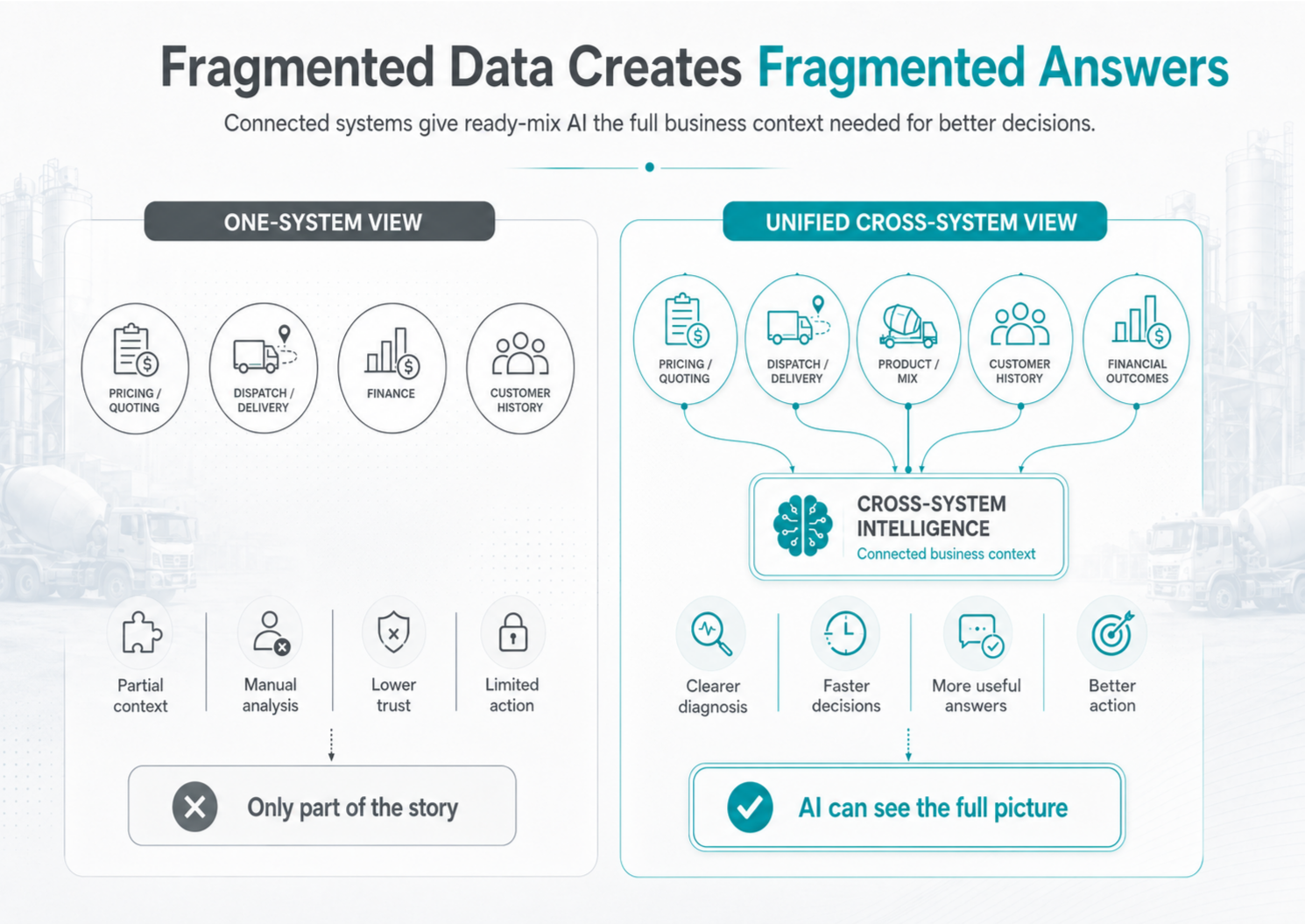
A dispatch system may show what moved and when. A pricing workflow may show what was quoted. A finance or ERP environment may show posted results. Each system can be valuable on its own, but none of them tells the full story behind margin, service performance, cost to serve, or operational risk.
That creates blind spots.
A producer may know that a job underperformed financially but not immediately see whether the issue was pricing, load size, route complexity, wait time, product selection, service demands, or a combination of several factors. The signals exist, but they are fragmented.
In our experience working with ready-mix producers, this is one of the main reasons AI can appear promising in theory but disappointing in practice. When the system sees only part of the business, the answers are limited by design.
Why ready-mix decisions are cross-functional
Most important ready-mix decisions are not confined to one workflow.
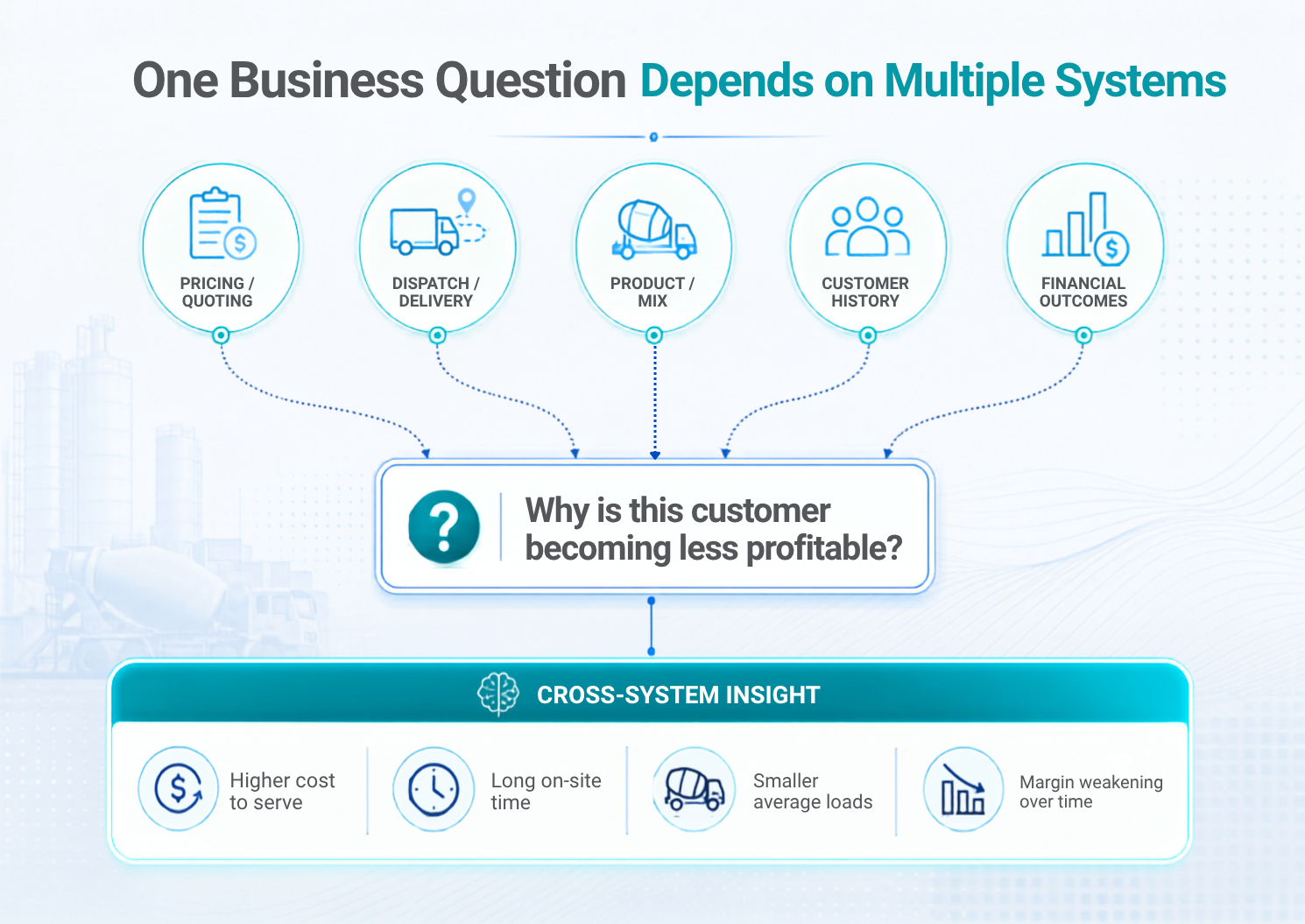
Consider a basic profitability question. A producer may want to understand why a customer, product, or job is underperforming. That question touches pricing, production, delivery, customer behavior, and financial outcome at the same time.
The same is true for many operational questions:
-
Why is cost to serve rising?
-
Which customers are becoming harder to serve profitably?
-
Are dispatch inefficiencies affecting margin?
-
Which products create more operational friction than expected?
-
Where is the business absorbing extra effort without recovering it?
These are not single-system questions. They require cross-system context.
That matters because AI is only as useful as the business reality it can see.
More data is not the same as unified data
Many organizations know they have a lot of data. What they often lack is a connected data environment that gives AI enough structure and context to reason across the business.
Having information spread across multiple systems is normal. The challenge is making those systems work together in a way that supports better answers.
Unified data does not mean replacing every platform. It means bringing together the commercial, operational, and financial signals that actually drive performance.
Without that, teams typically face one of two outcomes:
- AI that is narrow because it only sees part of the operation
- Analysis that depends on manual effort to connect the dots afterward
At C60, we see teams spend significant time reconciling data across systems before they can even begin to answer basic performance questions. That limits the value AI can deliver.
What happens when AI only sees one system
When AI is limited to one system, several problems tend to appear.
The answers lack depth.
They describe what happened in that system, but not the broader drivers behind it.
Margin explanations are incomplete.
A tool may flag an issue without showing the combination of pricing, delivery, product, and customer behavior that created it.
Actionability drops.
Teams receive information, but not clear direction on what to do next.
Trust becomes harder to build.
Users quickly recognize when answers do not reflect how the business actually works.
In ready-mix, leaders are not looking for abstract outputs. They want guidance that reflects operational reality.
What better cross-system intelligence looks like
The most effective ready-mix AI connects commercial and operational context instead of isolating them.
That means bringing together signals such as:
• Pricing and quoting data
• Customer history and service patterns
• Order and delivery activity
• Dispatch and logistics performance
• Product and mix information
• Financial and profitability outcomes
When these signals are analyzed together, the quality of insight changes.
Instead of asking, “What happened in this system?” teams can ask:
- Why is this customer becoming less profitable?
- Which jobs are creating higher service cost than expected?
- Where is margin weakening across plants, products, or routes?
- What changed operationally before this result showed up financially?
- What should we focus on next?
In our experience, this shift—from isolated reporting to connected insight—is where AI starts to deliver real business value.
Why this matters for AI adoption
Cross-system intelligence is not just a technical issue. It is an adoption issue.
When AI reflects the real complexity of the business, users are more likely to trust it. The answers feel grounded. The recommendations make sense. The system becomes useful across functions because it connects the same realities teams deal with every day.
When AI lacks that context, adoption slows. Users may try it, but often fall back to spreadsheets or traditional reporting because the outputs do not go far enough.
That is why architecture matters more than many buyers expect. The quality of the AI experience is shaped by the quality of the connected data behind it.
The goal is better decisions
The goal is not integration for its own sake. It is better decisions.
Ready-mix producers benefit from connected systems because unified data helps AI identify what matters, explain what is driving it, and support faster action.
In practice, that means better visibility into margin leakage, stronger pricing context, clearer operational understanding, and more confidence in the answers leaders rely on.
At C60, we see that AI does not struggle because the questions are too complex. It struggles when the business context is too fragmented.
That is why ready-mix AI needs more than one system.
The producers that get the most value from AI treat cross-system intelligence as a strategic requirement, not a technical afterthought.
If your AI only sees one part of the business, it will only answer one part of the question.
Want to see how C60 helps connect pricing, delivery, customer, and operational context into more useful ready-mix decision-making? Explore C60 in action.
Frequently Asked Questions
Why does ready-mix AI need more than one system?
Ready-mix decisions usually depend on pricing, customer, delivery, dispatch, product, and financial context at the same time. One system rarely contains enough information to explain profit, service performance, or operational risk on its own.
What is cross-system intelligence in ready-mix?
Cross-system intelligence means connecting data from multiple operational and commercial systems so AI can analyze the business more completely and provide more useful answers.
Why is one system not enough for AI in ready-mix?
One system may show only one part of the workflow, such as dispatch, pricing, or finance. That limits the AI’s ability to explain why results are happening across the broader business.
What problems happen when AI only uses one data source?
Common problems include incomplete answers, weak margin explanations, lower trust, and less actionable insight because the AI cannot see the full operational and commercial picture.
How does unified data improve AI decision-making in ready-mix?
Unified data helps AI connect pricing, delivery, customer, product, and financial signals. That makes it easier to identify margin pressure, explain performance changes, and support faster, more confident decisions.
