
[ Blog ]Where Ready-Mix Producers Lose Margin
Without Realizing It
Margin loss in ready-mix is rarely caused by one big, obvious problem.
Across the producers we work with at C60, we consistently see the same pattern: margin erosion builds quietly through small decisions, operational inefficiencies, pricing gaps, and execution issues that do not look serious on their own. A few extra minutes on site. A load priced slightly off. A delivery pattern that increases cost to serve. A customer relationship that looks strong on volume but underperforms on profit.
That is what makes margin leakage so difficult to manage. It hides inside normal operations.
For many producers, the challenge is not simply knowing margins are under pressure. It is understanding where that pressure is actually coming from.
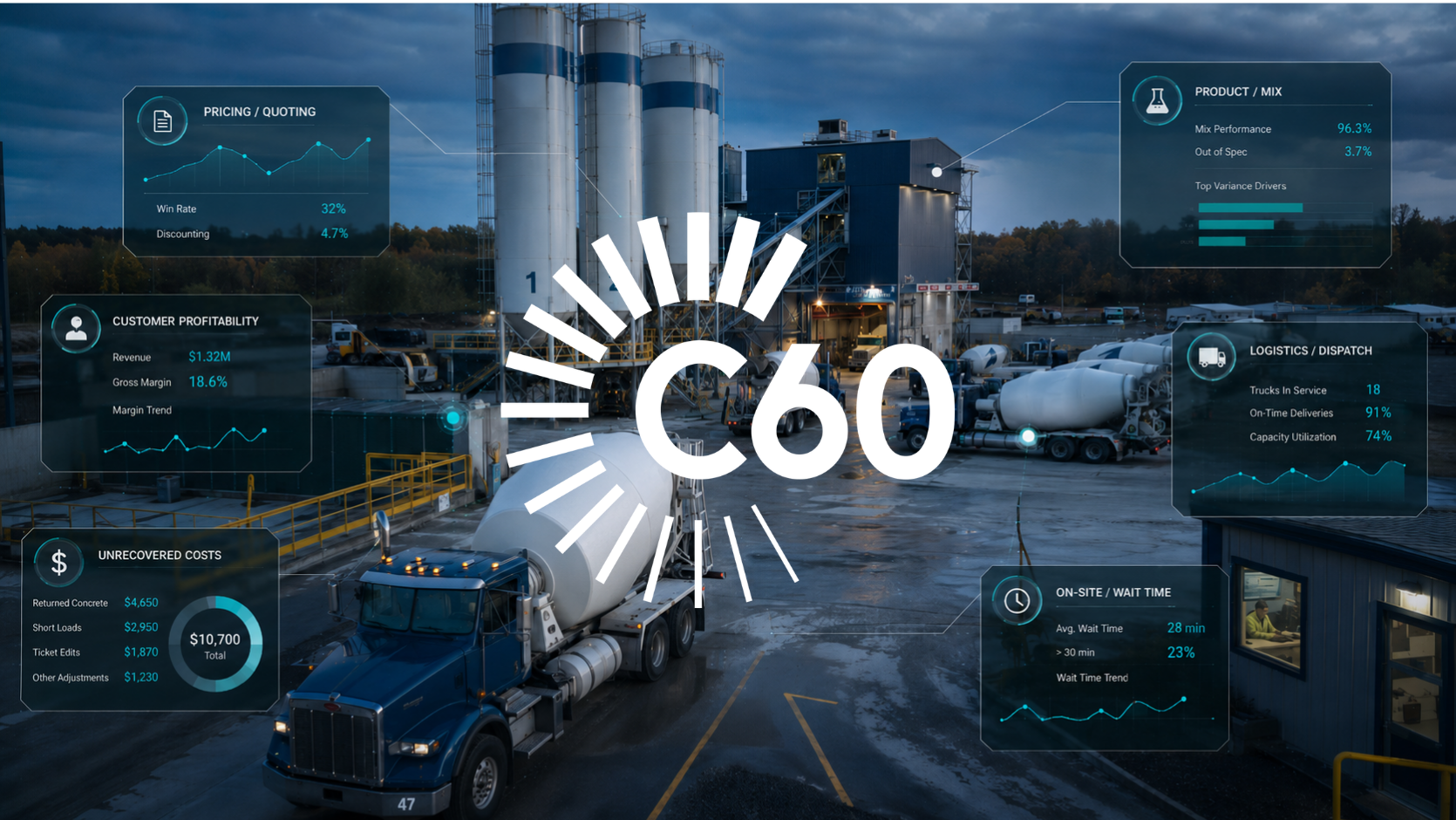
Margin leakage is usually distributed, not isolated
One of the biggest misconceptions in ready-mix is that margin problems will always show up clearly.
Sometimes they do. A poorly priced account or an unprofitable mix may stand out quickly. More often, leakage is spread across customers, products, jobs, delivery patterns, and daily execution. That makes it harder to detect with surface-level reporting.
A plant can appear busy. A customer can seem important. A product line can look healthy on volume. Yet margin may still be eroding because the true cost and effort required to serve that business are not fully understood.
That is where many producers lose money without realizing it soon enough.
Where margin often leaks in ready-mix
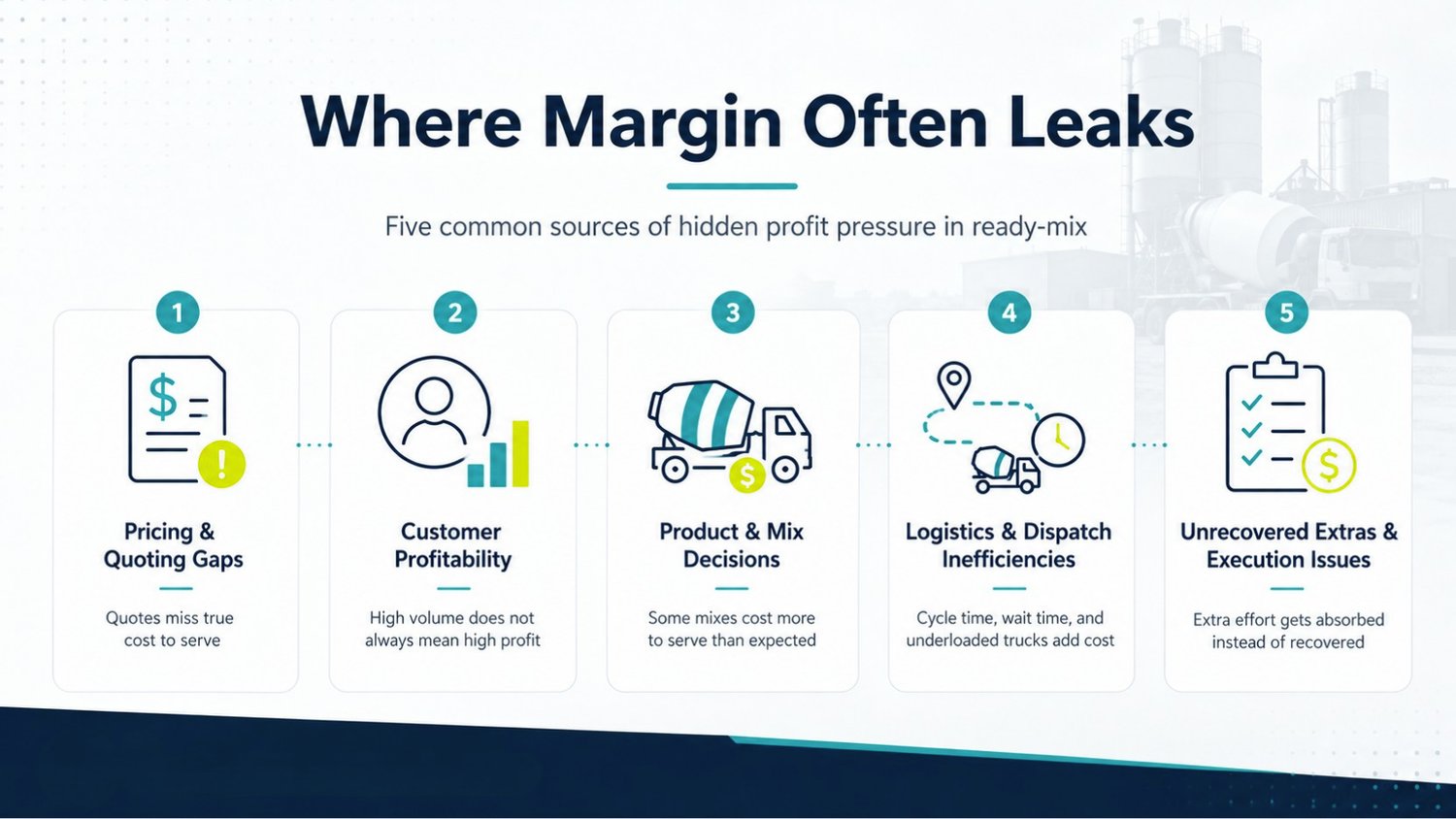
While every operation is different, margin leakage tends to appear in a familiar set of areas:
- Pricing and quoting gaps
Estimates may not reflect actual cost to serve, job complexity, delivery conditions, or customer-specific patterns. Small pricing errors compound quickly over time. - Customer-level profitability
A customer may generate strong volume but underperform once delivery effort, wait time, load size, and service demands are considered. - Product and mix decisions
Some products are more expensive to produce, handle, or deliver than expected. Without clear visibility, margin can disappear even on high-volume mixes. - Logistics and dispatch inefficiencies
Long cycles, underloaded trucks, extended on-site time, and poor sequencing all increase cost without always being tied back to margin. - Unrecovered extras and execution issues
Additional effort, special handling, or service complexity may never be fully captured in pricing. The work gets done, but the margin does not follow.
Why producers do not always see it early
Margin leakage is hard to spot because the signals live across multiple parts of the business.
Pricing data may tell one story. Dispatch and delivery data may tell another. Customer activity, product mix, and operational performance each hold part of the answer, but not enough on their own.
This creates a visibility gap. Teams can see individual metrics but struggle to connect them into a clear explanation of why profit is slipping.
Traditional reporting often shows what happened, but not why it happened or where to act. That is why margin leakage is frequently discovered after the fact, once the cost has already been absorbed.
Leaders do not just need reports. They need a better way to identify the drivers behind margin pressure.
The hidden cost of “good” business
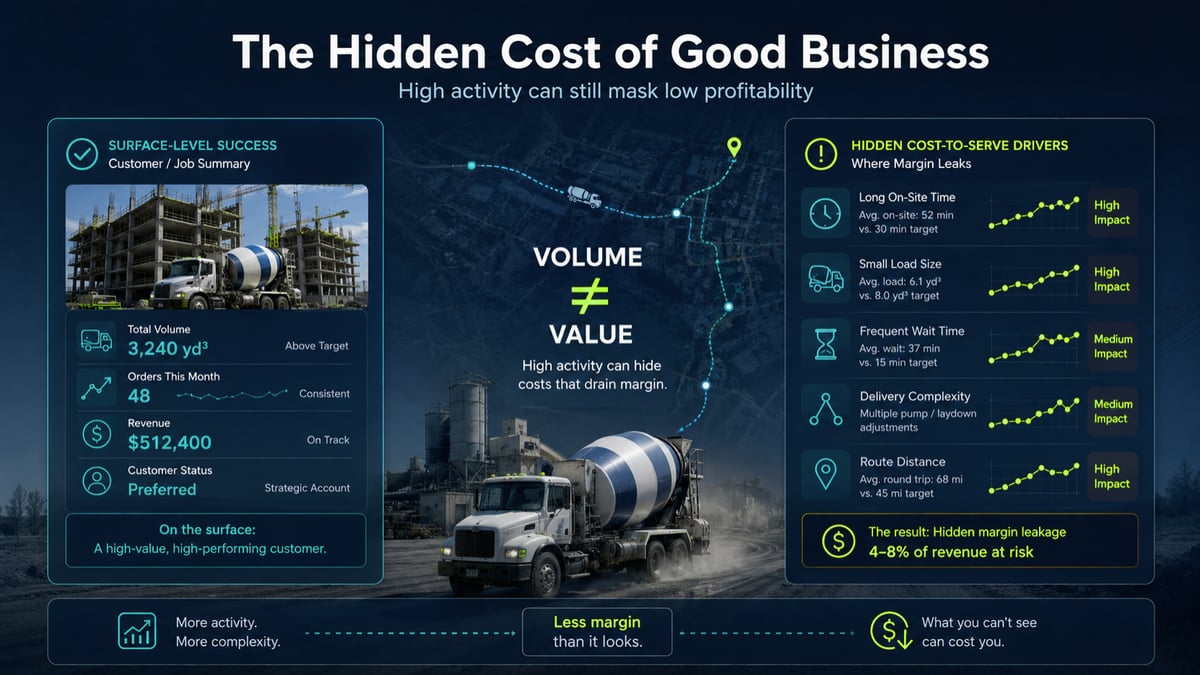
Some of the most dangerous margin leakage happens inside business that appears healthy.
A customer with steady orders may be expensive to serve. A job with acceptable revenue may involve too much waiting or too many small loads. A product with strong volume may create recurring cost pressure that gets lost in broader reporting.
In ready-mix, volume does not always mean value. Activity does not always mean profitability.
That is why producers need to evaluate margin with more context than top-line performance alone.
What better margin visibility looks like
Better visibility starts with asking better questions:
• Which customers are becoming less profitable?
• Which jobs are creating more delivery effort than expected?
• Which products or routes are increasing cost to serve?
• Where is margin weakening even though revenue looks acceptable?
These questions are more useful than reviewing margin after the period closes.
The strongest teams connect pricing, customer behavior, delivery performance, product economics, and execution patterns into a clearer view of where leakage is happening. That creates the opportunity to act earlier through pricing adjustments, operational improvements, or better account management.
This is also where AI can be valuable in ready-mix. By analyzing large volumes of operational data, it can highlight emerging risks, flag underperforming customers or jobs, and help teams focus on the areas that matter most for protecting margin.
The goal is not just to report margin loss
The real goal is to prevent it.
That requires more than dashboards or isolated KPIs. Producers need to identify the drivers of margin pressure while there is still time to act.
Margin leakage in ready-mix is often subtle before it becomes serious. That is exactly why it deserves attention.
The producers who improve profitability most consistently are not the ones who simply report margin more often. They are the ones who can see where it is slipping, understand why, and respond before the loss becomes normalized.
If margin pressure is showing up in your business, the most important question may not be whether it exists. It may be where it is hiding.
Want to see how C60 helps ready-mix producers identify hidden margin leakage across customers, jobs, products, and delivery performance? Explore C60 in action.
Frequently Asked Questions
What is margin leakage in ready-mix?
Margin leakage in ready-mix refers to profit loss that happens gradually through pricing gaps, delivery inefficiencies, product issues, service complexity, unrecovered costs, or customer-level underperformance that may not be immediately visible.
Where do ready-mix producers most often lose margin?
Common areas include pricing and quoting, customer profitability, product and mix economics, logistics and dispatch inefficiencies, long on-site times, underloaded trucks, and unrecovered extras tied to service or execution.
Why is margin leakage hard to identify in ready-mix?
It is hard to identify because the causes are often spread across multiple systems and functions. A producer may see pricing, delivery, or customer metrics separately without easily seeing how they combine to affect profit.
Can a high-volume customer still reduce profitability?
Yes. A customer can generate strong volume and still be less profitable than expected if the cost to serve is high, delivery patterns are inefficient, or pricing does not reflect the real effort required.
How can ready-mix producers reduce hidden margin leakage?
They can reduce hidden leakage by improving pricing context, tracking customer-specific cost to serve, reviewing delivery and dispatch performance, identifying recurring operational friction, and using better analysis to connect margin pressure to specific business drivers.
